 |
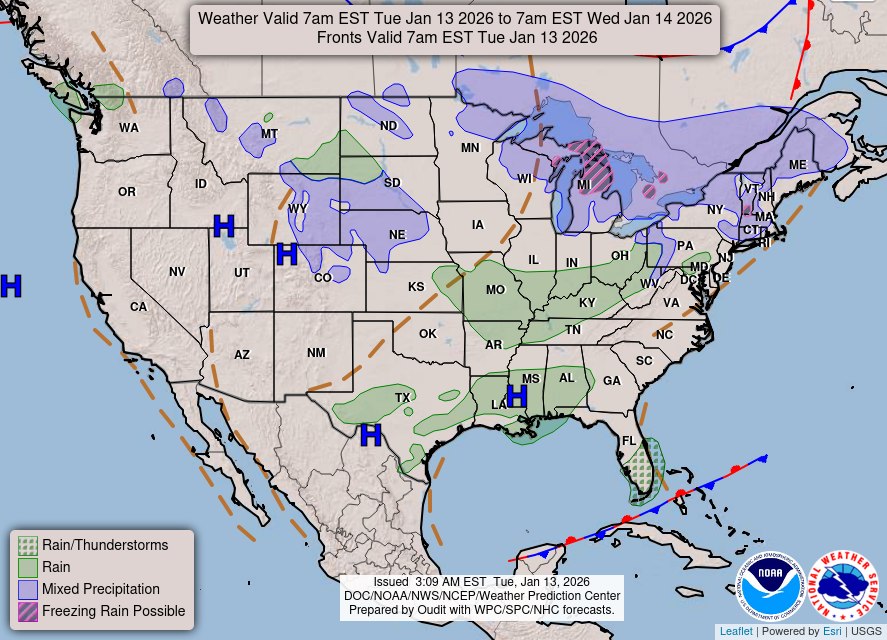
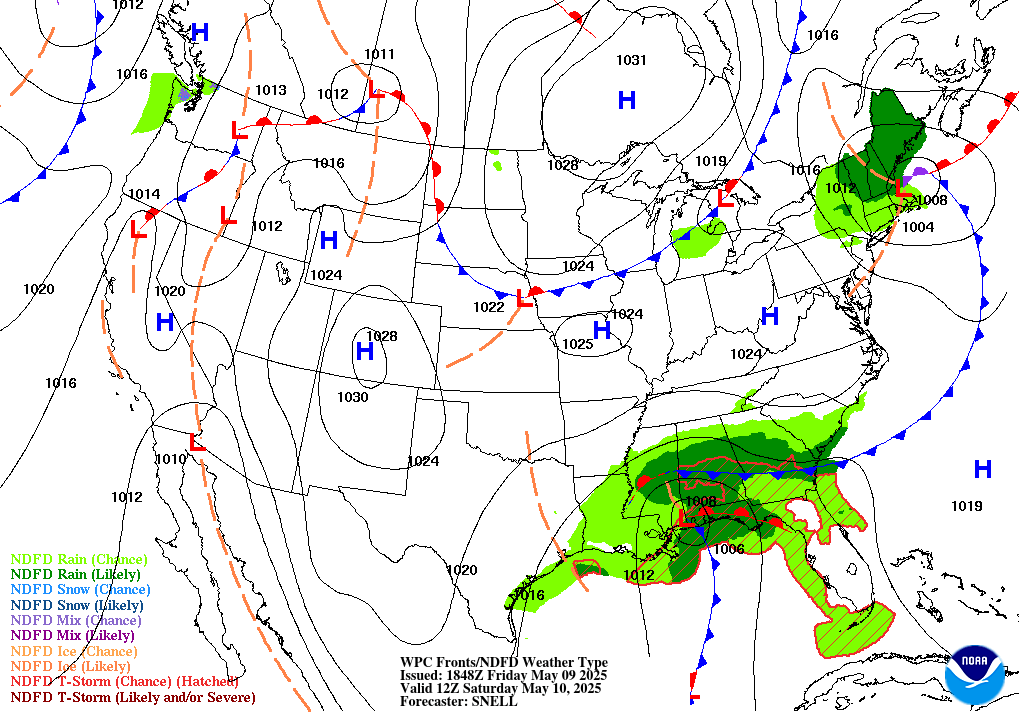
| Short Range Forecast Discussion NWS Weather Prediction Center College Park MD 223 PM EDT Mon Oct 19 2026 Valid 00Z Tue Oct 20 2026 - 00Z Thu Oct 22 2026 ...Nor�easter moving north just off the Mid-Atlantic Coast will produce scattered rain showers off and on along parts of the Mid-Atlantic and Northeast Coast through Wednesday... ...Low pressure moving southward along the West Coast will develop scattered rain over parts of California through Tuesday and heavier rain over the area on Wednesday... ...There is a Slight Risk of excessive rainfall over parts of the Southwest, Great Basin, and Central/Southern Rockies on Wednesday... Low pressure off the North Carolina coast will linger near the Mid-Atlantic Coast before moving eastward out over the Atlantic by Wednesday evening. Moisture circulating around the low will produce rain off and on over parts of the Northeast and Mid-Atlantic Coast through Wednesday. The low will develop and intensify and wobble well off the North Carolina coast early this week before slowly tracking east and exiting the region by Thursday. As it strengthens, the storm will likely bring long-duration coastal impacts to portions of the Mid-Atlantic, especially for the North Carolina Outer Banks. Persistent, strong onshore winds will bring moderate coastal flooding, dangerous marine conditions, and beach erosion, especially during high tides, from southern New Jersey through the North Carolina coast into mid-week. The storm is likely to bring wind gusts in excess of 45 mph across the Outer Banks region and the Virginia Tidewater. Furthermore, details on the magnitude and location of impacts are still evolving as conditions deteriorate. Check weather.gov regularly for the latest updates. Elsewhere, a second area of low pressure over the Eastern Pacific will move southward along the West Coast, bringing scattered rain to parts of the Pacific Northwest and Northern California coast through Tuesday morning. On Tuesday, a plume of moisture will stream into California and the Southwest, creating showers and thunderstorms with heavy rain. Therefore, the WPC has issued a Slight Risk (level 2/4) of excessive rainfall over parts of the Southwest, Great Basin, and the Central/Southern Rockies on Wednesday through Thursday morning. The associated heavy rain will create mainly localized areas of flash flooding, with urban areas, roads, small streams, narrow canyons/gullies, and burn scars the most vulnerable. Lastly, a weak stationary front south of Florida and easterly flow off the Atlantic will produce scattered rain and embedded thunderstorms over Florida s eastern coast and the Florida Keys through Wednesday evening. Moreover, easterly flow off the Gulf will produce rain with embedded thunderstorms over the southern tip of Texas through Wednesday. Ziegenfelder |
 |
 |
 |